Important Dates
| Milestone | Date |
|---|---|
| Paper Submission | |
| Notification to Authors | June 30, 2026 |
| Registration Deadline | July 10, 2026 |
| Camera Ready Submission | July 20, 2026 |
| Conference Date | July 24-25, 2026 |
Submission Guidelines
All paper submissions must be made through the Microsoft CMT platform. You must create an account on the CMT platform to submit your paper. The submission link will be available soon.
For any issues related to the submission process, please, feel free to contact us: info@icaisf.comAuthors may use Generative AI tools responsibly for language improvement, grammar correction, formatting, coding assistance, literature support, or improving the readability of the manuscript. However, the final submission must represent the authors' own original intellectual contribution.
Generative AI tools — including ChatGPT, Gemini, Claude, Copilot, or any similar system — cannot be listed as authors or co-authors. Authorship is limited to human contributors who can take full responsibility for the content, originality, accuracy, and integrity of the submitted work.
Authors must clearly disclose any substantial use of Generative AI tools. Authors should add a separate section titled "Generative AI Declaration" immediately before the References section, providing details of: the tool used, purpose of use, sections of the manuscript where the tool was applied, and any figures, tables, code, data analysis, methodology, literature review, or research ideas assisted by such tools. Basic grammar correction or language polishing does not require mandatory disclosure.
Authors are fully responsible for verifying all content produced or assisted by Generative AI tools, including facts, references, citations, equations, code, results, figures, and conclusions. Fabricated citations, false claims, manipulated results, generated fake data, or misleading figures are strictly prohibited.
Images, diagrams, tables, or figures created or substantially modified using Generative AI tools must be clearly identified and disclosed. Such content must not misrepresent experimental results, real datasets, real photographs, or actual implementations.
Reviewers, Program Committee members, and Editors must not upload submitted manuscripts, reviews, author responses, figures, tables, code, or supplementary materials to public Generative AI tools or external platforms. All submissions and review materials must be treated as strictly confidential.
If a manuscript appears to be substantially generated by Generative AI tools, particularly where such use has not been disclosed, the submission may be subject to further editorial review. If the content is found to lack sufficient original scholarly contribution, contain fabricated or unverifiable material, or violate the conference policy on the use of Generative AI tools, the paper may be desk rejected or rejected at any stage of the review process.
Camera-Ready Guidelines
Please note that it is mandatory that authors must address all the changes suggested by the reviewers (if any). Authors must follow the three steps below to complete their camera-ready submission.
Step 1: IEEE-Xplore-Compatible PDF Generation
Authors must convert their paper to PDF format and verify its compatibility using the IEEE PDF eXpress tool available at ieee-pdf-express.org.
To use the tool, create an account with the following details:
- Conference ID: 70757
- Your email address
- A password of your choice
Previous users of IEEE PDF eXpress should use the same username and password as used for previous conferences. After uploading your paper, you will receive an email indicating whether the file has passed or failed validation. Your paper must pass validation before proceeding to the next step.
Step 2: Camera-Ready Paper Submission
Once you have an IEEE Xplore-compatible PDF, log in to Microsoft CMT and go to the Author Console. Select "Create Camera Ready Submission", upload your validated PDF file, and click Submit.
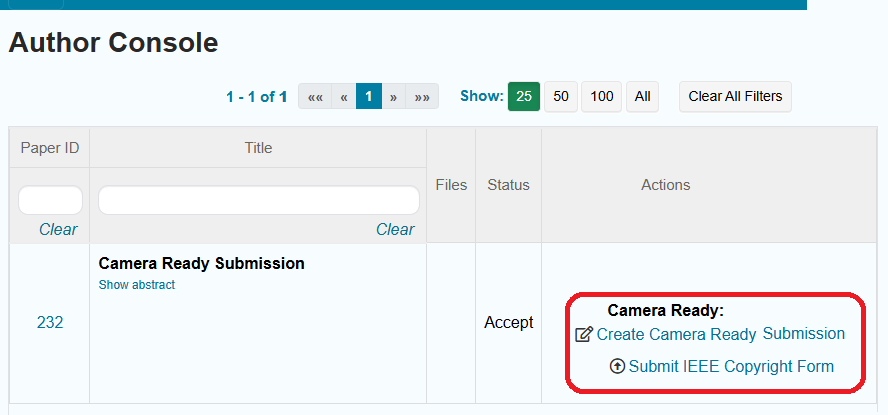
Figure 1: Creating camera-ready submission and IEEE Copyright Form submissions in Microsoft CMT.
Step 3: IEEE Copyright Transfer Form Submission
To enable inclusion of your paper in the conference proceedings and IEEE Xplore, at least one author must complete the IEEE copyright transfer form. This can be done directly through Microsoft CMT by providing the corresponding author's details.
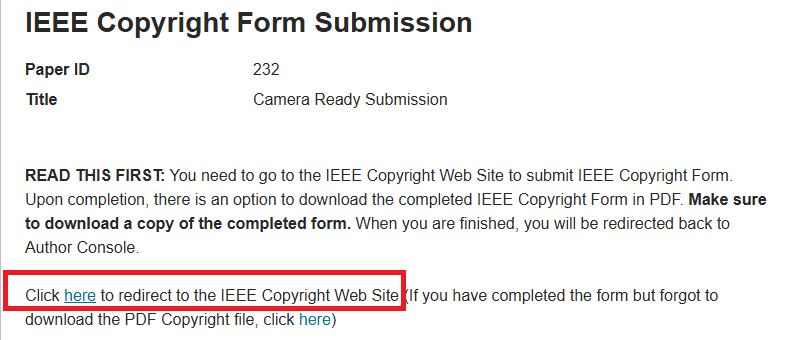
Figure 2: Accessing the IEEE Copyright Transfer form in Microsoft CMT.
How to Upload Camera-Ready Materials via CMT
Follow these steps to complete your submission on Microsoft CMT
- The IEEE Xplore-compatible PDF approved by IEEE PDF eXpress (Conference ID: 70757)
How to view reviewer comments in CMT: In Author Console, open your submission and click View Reviews to read reviewer feedback before finalizing updates. You can also Create Camera-Ready or Edit Camera-Ready from the same CMT submission area as shown below.
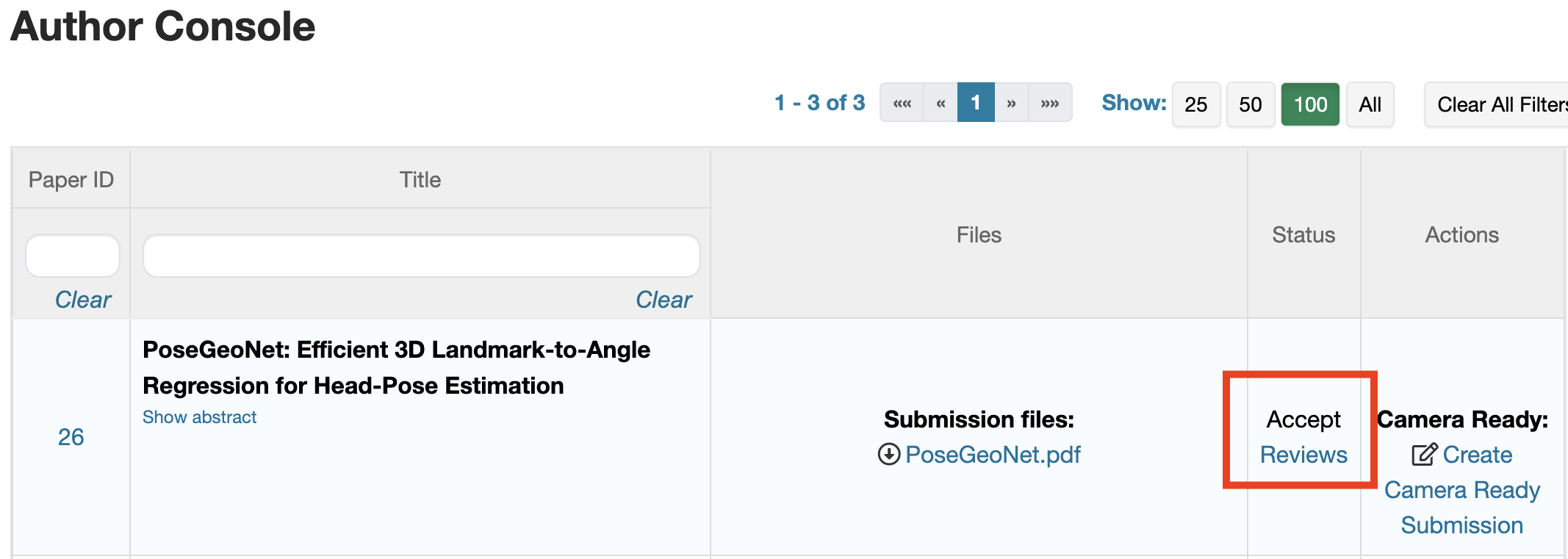
CMT Author Console — open your submission to view reviews and manage camera-ready files.
Camera-Ready Submission Checklist for Authors
Please go through every point carefully before uploading your files to CMT.
Reference Details and Common Mistakes: Each reference must be complete and accurate. Include full author names, complete title, journal or conference name, volume, issue, page numbers, publisher where applicable, year, and DOI where available. Incomplete or AI-generated references must be corrected before camera-ready submission.
For any issues related to the camera-ready submission process, please contact us: info@icaisf.com
Technical Paper Guidelines
Expected structure and technical content guidelines for ICAISF paper submissions.
The title should be compact, specific, and directly relevant to the research problem. It should clearly indicate the main idea, proposed method, and application area where applicable. Avoid vague, overly long, or general titles.
The abstract should briefly summarize the problem, proposed method, major contribution, and key findings. It should be concise and focused, preferably within one short paragraph. Do not include citations, equations, or special characters.
Keywords should be written in one line only. Include 4 to 6 relevant terms that represent the research area, method, dataset/domain, and application.
Do not use subheadings inside the introduction. Write two to three connected paragraphs:
- Paragraph 1: Introduce the broader research area and its importance.
- Paragraph 2: Explain the specific research problem, limitations of existing work, and the research gap.
- Paragraph 3: Briefly introduce the proposed work.
Do not use subheadings inside the related work section. Critically analyze at least 12–15 recent and relevant research papers. The discussion should compare methods, datasets, strengths, limitations, and research gaps. Avoid writing only descriptive summaries of papers.
This section may include subsections. It should clearly explain how the research was conducted and provide enough technical detail for reproducibility.
Describe the dataset source, size, features, classes/categories, data format, preprocessing steps, and any data split used for training, validation, and testing.
Explain the complete workflow of the proposed approach from input to output. Include a block diagram, flowchart, or system architecture diagram where possible. Clearly explain each major step, model, framework, or technique used.
If the paper includes a computational method, model pipeline, or decision-making procedure, include an algorithm or pseudocode. Clearly mention input, processing steps, and output.
Briefly describe the programming language, tools, libraries, frameworks, hardware, operating system, GPU/CPU, RAM, or cloud environment used for implementation.
This section should present the strongest evidence of the proposed work. It may include the following subsections:
Briefly explain how experiments were conducted. Mention dataset split, training/testing protocol, validation strategy, baseline methods, parameter settings, and hardware/software setup.
Select metrics appropriate to the research problem:
- Classification: Accuracy, Precision, Recall, F1-score, Confusion Matrix, ROC-AUC, Specificity
- Regression: MAE, MSE, RMSE, R-squared
- Detection / Segmentation: IoU, mAP, Dice Score, Pixel Accuracy
Include formulas where necessary.
Clearly present results using tables, figures, graphs, confusion matrices, or qualitative examples. Compare the proposed method with baseline methods. This part must clearly show the improvement, effectiveness, or usefulness of the proposed method.
Discuss failure cases, limitations, unusual results, and technical reasons behind observed performance. Do not only repeat values from tables. Explain why the method performed well or poorly and what the findings mean.
Write the conclusion as one compact paragraph. It should summarize the research problem, proposed approach, major achievements, and significance of the results. Mention future work briefly within the same paragraph. Do not create a separate Future Work section.
References must follow IEEE numerical citation style. Each reference should include complete details: author names, paper title, journal or conference name, volume, issue, pages, year, DOI, and URL where available. References must be numbered in the order they appear in the paper.
Presentation Guidelines
All authors are requested to carefully follow the guidelines below while preparing their presentation slides for ICAISF. These guidelines apply to both in-person and online presenters.
Presentation time allocation:
- In-person presentations: 20 minutes total, with 15 minutes maximum for the presentation followed by 5 minutes for Q&A.
- Online presentations: 15 minutes total, with 10–12 minutes for the presentation followed by 2–3 minutes for Q&A.
Multiple authors may present their paper together, provided the presentation remains within the allocated time limit.
- The presentation should ideally contain 10–12 slides only. As a general guideline, presenters will have approximately 1 minute per slide.
- Keep slides simple, clear, and professional:
- Avoid long paragraphs
- Use concise bullet points
- Use readable font sizes
- Minimise animations and transitions
- Ensure all figures, tables, and charts are high quality and clearly visible
- We encourage you to include the ICAISF Conference logo and title on your slides.
- Audience members are requested to ask questions during the Q&A session at the end of each presentation.
Recommended Slide Structure
- Title slide with author information
- Introduction and motivation
- Research objectives and key contributions
- Materials and methodology
- Results and discussion
- Conclusion and future directions
- Q&A
Additional Requirements for Online Presenters
- Ensure a stable internet connection before the session begins.
- Use quality audio equipment — a headset or external microphone is recommended.
- Have a power backup ready to avoid interruptions.
- Present from a quiet environment free from background noise.
- Join your session at least 10 minutes early with your presentation ready in both PowerPoint and PDF formats.
Session Procedures
The conference spans two days. Different sessions will be arranged, and you will present your paper live in your assigned session. The session chair will introduce each presenter according to the conference schedule. Please wait for your turn — the session chair will invite authors in sequence. Strict adherence to time limits is mandatory.
Review Process
- All submitted papers will be reviewed by at least 2 independent reviewers. Additional reviewers will be consulted if required.
- All papers will go through a plagiarism checker. The plagiarism report must not exceed 15%. Any paper exceeding this threshold will not be included in the proceedings.
- All papers must be formatted according to the IEEE template.
- Paper acceptance will be based on originality, significance, technical soundness, and clarity of presentation.
- Authors must make sure that they submit previously unpublished papers to this conference.
Awards & Participation
- All accepted papers that are presented will be awarded a presentation certificate.
- The Best Paper certificate will be awarded to the author(s) of the best paper. The selection will be based on reviewers' comments and recommendations of the session chair.
Technical Sponsors